
He karakia
Nā Te Mete Lowman i tito mō te rōpū rangahau whatu kākahu
| Tēnei au, tēnei au | Here I am, here I am |
| Ko te rangi ki runga | The sky is above |
| Ko te papa ki raro | The land is below |
| Ko ngā āhuatanga o te ao kikokiko | There are the physical elements |
| Ko ngā āhuatanga o te ao wairua | There are the spiritual elements |
| E kōtuitui ana i te muka tangata | Which weave together the fibres of people |
| I raro i te whatu kākahu atawhai | Under the safety of the protective cloak |
| E mau nei ki ngā wawata | That bears the aspirations |
| Me ngā moemoeā o ngā tūpuna | And the dreams of the ancestors |
| Kimihia, rangahaua | Search forth and pursue |
| Kia mau, kia ita | To obtain and hold tightly |
| Kia puta ki te whaiao | So you may stand in the world of light |
| Ki te ao mārama | The world of understanding |
| Tēnei whenu i here | This strand that binds |
| Taku mana | My mana |
| He mana tuku iho | The mana that was given to me |
| Nō tuawhakarere | From those before my time |
| Kōkiri | Forward we go |
| Whatuora ki a tātou! |
Introduction and project context
Māori arts-based practice or toi Māori, including visual arts, performing arts, and Māori creative practice, celebrates language, culture, and distinct approaches to the intergenerational transmission of aspirations to live and thrive as Māori. Māori pedagogies such as ako and tuakana–teina (Hemara, 2000) have become part of educational discourse in Aotearoa New Zealand (Ministry of Education, 2008; Ministry of Education & New Zealand Teachers Council, 2011). These Māori centric approaches to teaching and learning have arguably been adapted, adopted, and appropriated into English medium classrooms with varying degrees of enthusiasm and success. This research takes up, and seeks to extend on, pūtoi ako Māori—a Māori-medium education term to describe pedagogical approaches particular to these settings. There remains, however, a dearth of Māori practice-based educational research that seeks to theorise and implement emerging Māori pedagogies—and even fewer that celebrate the inherent and embodied knowledge of toi Māori pedagogies.
Rationale
The historical role of education in Aotearoa New Zealand has been as a tool of colonisation, with systematic efforts to suppress Māori language and culture (Higgins et al., 2014; Selby, 2014; Walker, 2004). Colonial schooling sought to replace Māori epistemologies with Western knowledge systems, undermining Māori aspirations to live “as Māori” (Durie, 1998; Selby, 2014; Simon & Smith, 2001). These historical legacies continue to shape contemporary educational experiences, where pūtoi ako Māori are often marginalised or treated as supplementary to dominant Western paradigms.
Decolonising activations around reclamation and revitalisation are not new to Māori. The “Māori renaissance” of the 1970s and 1980s saw “flaxroots” movements unfold on marae and in urban and rural communities across the country (Walker, 2004). Collective activations, such as the 1975 Land March, the 1986 Māori Language petition, Māorimedium education, and initiatives to revitalise toi Māori, were driven by Māori aspirations for decolonisation and creating transformational and generational change. More recently, concerning political shifts to de-centre the Treaty of Waitangi led to the Toitū Te Tiriti movement.
Māori language revitalisation movements have made significant gains over the past four decades. Māori-medium education, or Māori language immersion settings, such as the three rumaki reo settings in this research, are oversubscribed, reflecting clearly that whānau Māori actively seek ways to revitalise language, culture, and identity as educational sovereignty. A creative project deserves a creative project report; therefore, literature and theory, stories and practice, are taken up as threads of knowing and woven by the research team in relationship with whānau from three interrelated rumaki reo settings in west-central Auckland.
Whatu pedagogy and kaupapa Māori framework
A theorisation of toi Māori pedagogy binds together toi Māori, kaupapa Māori research, teaching and learning, and in-school practice. Bound together, this rangahau celebrates the distinctive knowledge embodied in the toi Māori practice of whatu and the whatu kākahu it produces, while contributing to a kaupapa Māori agenda that develops teaching and learning approaches supporting Māori aspirations to live and learn “as Māori” (Durie, 1998; 2003). Centring toi Māori practice as teacher builds on previous research of whatu underpinned by whatuora methodology (Smith, 2017, 2019, 2021, 2023), and relationships formed when teaching whatu to tauira (students) in these schools. While early—often male and Pākehā—ethnographers (Smith, 2017; Smith & Laing, 2011) documented weaving techniques and uses of textiles, little attention was given to how knowledge was transmitted through language, action, and intergenerational learning. We are left to wonder about how and why our tūpuna transferred knowledge, skills, and story. Theorising whatu as pedagogy—the how and why we teach the way we do—adds “new” knowledge to well-used yet often simplified Māori pedagogies, such as tuakana– teina and ako, and encourages further research to expand and deepen our thinking about Māori pedagogy for advancing Māori-medium education.
Project context—weaving relationships
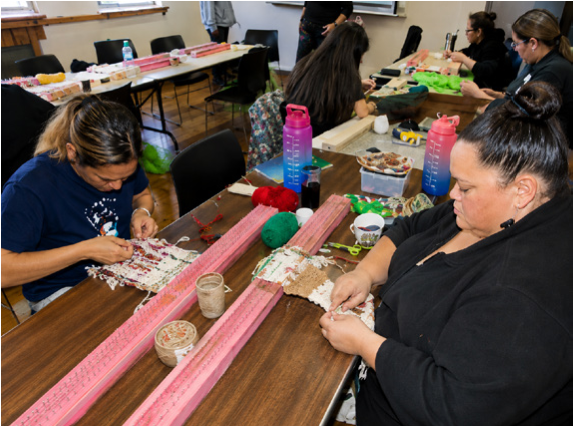
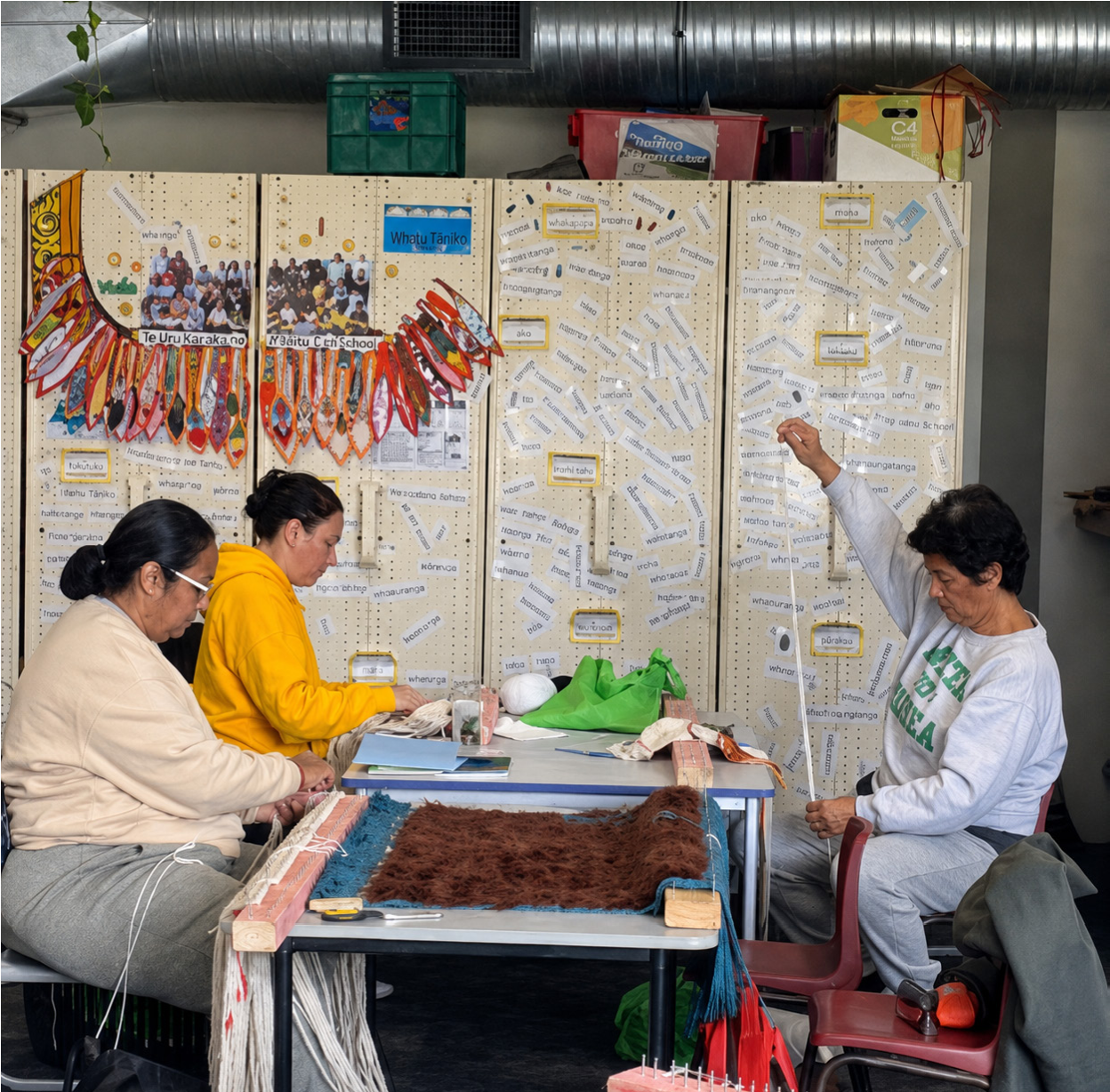
In 2021, a co-designed whatu wānanga was created with 20 Years 7 and 8 students at Te Waitītiko rumaki reo, Pasadena Intermediate. Principal investigator Hinekura Smith (then a kura parent) taught the students over two terms and held four weekend wānanga with more than 30 parents and whānau. During these gatherings, the students became the teachers, working alongside their parents, aunts, cousins, and siblings, passing on their emerging whatu skills and the language they had developed. Each whānau set a goal— to weave a whatu kākahu for their child’s graduation. Building on this success, the team secured Whatua Tū Aka funding (2023–25) to extend this community of practice to three rumaki reo settings: Te Uru Karaka (Newton Central Primary); Te Waitītiko (Pasadena Intermediate); and Ngā Puna o Waiōrea (Western Springs College), a well-established west-central Auckland Māori-medium pathway.
Across the current 2-year project, Hinekura Smith and Kim Penetito enacted an a/r/ tographic approach (Irwin & Springgay, 2009), intertwining roles as artist-weavers, researchers, and teachers. Whānau from the three kura participated in a year-long series of weekend wānanga, each aiming to weave a whatu kākahu for their tamariki mokopuna. All achieved this goal, with many weaving several more. As they learnt, they spoke of the determination that their children and grandchildren would have reo, tikanga, and an affirmed identity that earlier generations were denied.
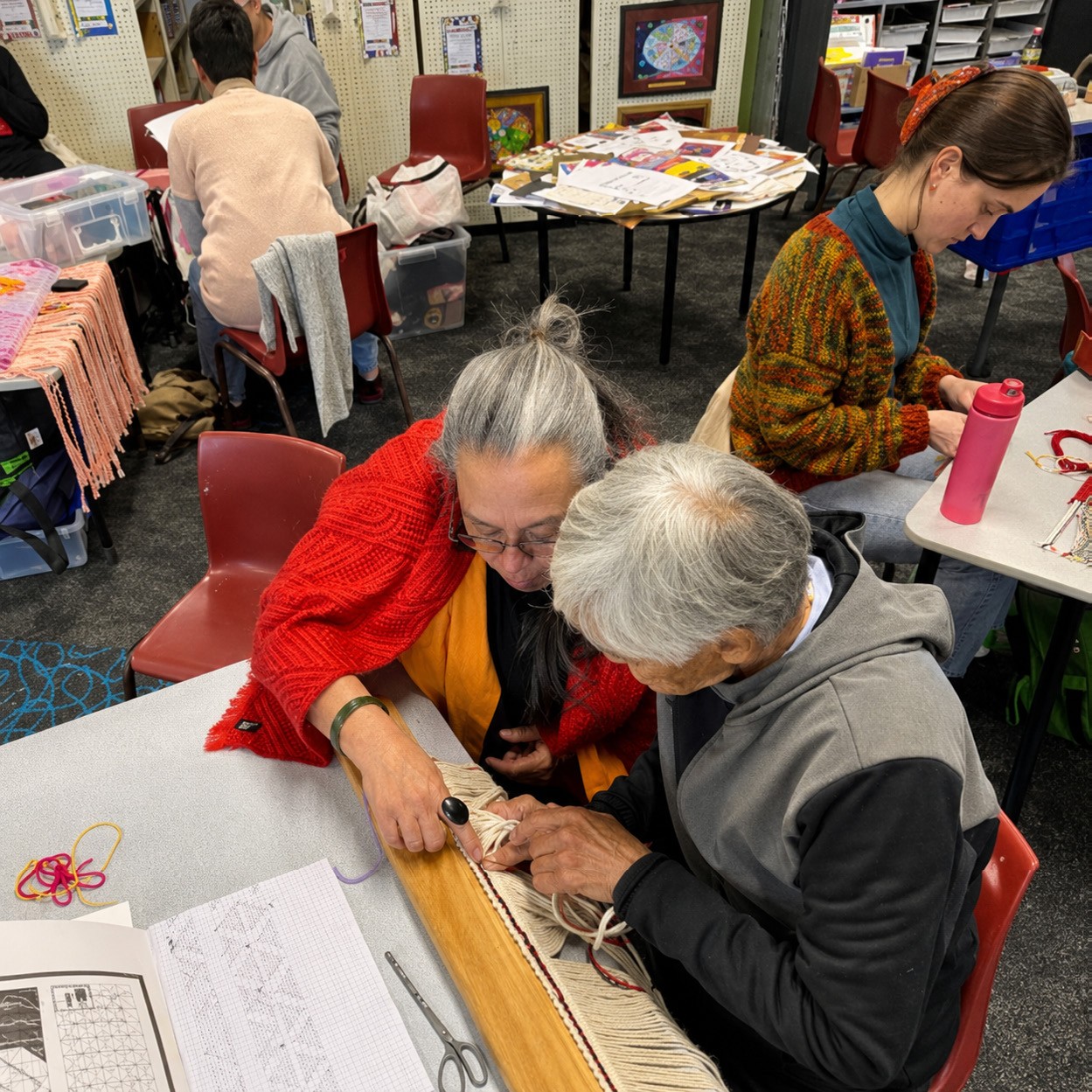
Whānau described the joy of learning with their children, realising long-held aspirations to make a whānau cloak, and connecting across kura. Immersed in te reo Māori, they found “quiet whatu thinking time” and creative Māori space to be together. Tamariki confident in te reo Māori (aged 6–17) often led the learning—questioning, translating, and reinterpreting whatu language into their own patterns of meaning. Many were more fluent than their parents, guiding them with varying degrees of patience.
The work of whatu pedagogy—to enable whanaungatanga, ako, and language transmission—was clear. Whatu wānanga as a toi Māori pedagogical space fostered transgenerational knowledge flow: language learning moved “up” from child to grand/ parent, while memories and stories flowed “down” from grand/parent to child. This project shows what is possible when toi Māori, such as whatu, is explored as more than art, but as pedagogy itself—opening new possibilities to explore toi pedagogy across haka, raranga, and other creative forms.
Toi ora, reo ora: Developing whatu pedagogy in language
A point of difference of Toi Ora, Reo Ora, Whatuora! is the development of whatu pedagogy through te reo Māori and the embodied language and terminology of the practice itself. While there are increasing opportunities to learn to “make Māori cloaks”, there is a dearth of scholarship examining their linguistic and epistemic dimensions. A small literature set (Smith, 2017; Tamarapa, 2011; Te Kanawa & Turi-Tiakitai, 2011) highlights the significance of whatu kākahu as sites of knowledge, but much remains to be explored regarding their pedagogical potential. This research argues that the language, methodology, pedagogy, and practice of toi Māori deserve attention and should be revitalised interdependently. To revitalise a toi Māori practice without its language and pedagogy is to only do half the job and is incongruous with a kaupapa Māori agenda.
Research aims and questions
The aim of this project was to explore whatu pedagogy as a kaupapa Māori research approach to story whānau aspirations for their tamariki mokopuna—aspirations shaped by historical and contemporary experiences of education. If aspirations are understood as taonga tuku iho—values, beliefs, and ideas transmitted intergenerationally—then weaving these aspirations into the educational fabric becomes a critical act, and one that is important for education stakeholders to hear, see, feel, and understand. The research is guided by the following question:
How does whatuora, a kaupapa Māori arts-based pedagogy, support and story the intergenerational flourishing of Māori language, culture, and whānau aspirations across three Māori-medium educational settings?
Subquestions include:
- What does whatu teach us (Māori-medium students/whānau/kaiako/researchers) and how does it teach?
- How might whatu pedagogy contribute to a growing multiplicity of Māori pedagogies about how we learn in Māori-medium education settings?
- What might whatu pedagogy add to ways of teaching and learning in Māorimedium education?
- How does developing whatu pedagogy encourage the theorisation of other Māori pedagogies to support teaching and learning in Māori-medium education?
Intended impact
The project generated both theoretical and practical contributions to enrich the field of pūtoi ako Māori (Māori pedagogy) by theorising whatu as a distinct toi Māori pedagogy. It demonstrated a kaupapa Māori–toi Māori practice-based model for embedding language learning, cultural knowledge transmission, and intragenerational engagement through creative practice. For policy and curriculum, this study supports embedding toi Māori pedagogies—not just practices—in Māori-medium education. Ultimately, this work responds to the aspirations of whānau Māori for their children to thrive as Māori, contributing to the revitalisation of language and culture, and to systemic educational transformation in Aotearoa New Zealand.
Research design, methods, and analysis
Kaupapa Māori methodology: Weaving research capability
This kaupapa Māori education research project intentionally drew together a research team of Māori educators, artists, and established and emerging researchers to grow kaupapa Māori research. Allana Goldsmith, a creative emerging researcher, joined the team as a research assistant and Master’s student in 2023, where she led and published her first journal article—a literature review of whatu pedagogy (Goldsmith et al., 2024). Alongside building research team capabilities, we were most excited by the ways that whānau themselves became co-researchers—speaking, writing, and weaving their stories in their own words—and, in doing so, moving beyond being research subjects to becoming research active.
Emerging from kaupapa Māori theory, whatuora methodology (Smith, 2017, 2021) twines together the practice of whatu, with the concept of ora, meaning to be well, safe, and thriving (Williams, 1997). Whatuora activates traditional weaving knowledge as a site of methodological and pedagogical theorising, cultural regeneration, and decolonising praxis to inform the design of the research, interactions with whānau, the thematic analysis of data, and its dissemination through:
- whatu wānanga—gathering knowledge in context through sustained weaving wānanga held in kura
- whatu kōrero—bringing a whatu logic to analysis, weaving themes through whānau voices, encouraging participants to write, speak, and tell their own stories
- whatu kaupapa—creative dissemination that returned knowledge to the communities it came from, ensuring findings were accessible and meaningful for the community.
Participants
The project centres on a rumaki reo (Māori-language immersion) pathway in urban west-central Auckland: Te Uru Karaka (Newton Central Primary); Te Waitītiko (Pasadena Intermediate); and Ngā Puna o Waiōrea (Western Springs College). The project was supported by kaiako and kura leaders, some of whom attended the wānanga. A total of 44 whānau members participated in a series of weekend whatu wānanga held over one year. While all interviewed participants were Māori, the broader wānanga was open to any whānau involved in the three settings and therefore welcomed non-Māori family members, parents, and kaiako (including three Native American visiting Fulbright scholars) to learn alongside us. Ten whānau Māori, including parents, grandparents, aunties, uncles, and siblings, were interviewed one-on-one or in small intergenerational groups.
Rich qualitative data were gathered through whānau interviews, whole-group wānanga discussions, and the participants’ own writing. Rather than extracting information, the whatu research methods created space for stories to rise naturally through shared making, conversation, and reflection.
Whānau wānanga/small-group interviews (n = 10)
Semistructured, intergenerational whānau interviews were held during weekend wānanga. Every second month, one kura hosted a wānanga, ensuring the research was located in spaces that were familiar and accessible to whānau and their tamariki mokopuna. Whānau interviews were intergenerational by design: sometimes one parent, a parent and child, or a parent, grandmother, and mokopuna. Conversations unfolded in both te reo Māori and English, often while participants continued to weave. Each 1–2-hour interview was recorded, transcribed, and returned for participant review and approval. The resulting data were moving, complex, and grounded in stories of courage, emotion around language loss, and the how and why whānau made deliberate choices to educate their children in Māori-medium as a strategy to interrupt cycles of language and cultural oppression.
Wānanga kōrero as an emergent whatu kōrero method
As the relationships grew among whānau across the three kura, an unanticipated dataset emerged. Each wānanga began with karakia, then, once settled and weaving, Hinekura would offer a whakaaro (a prompt, question, or provocation) to reflect upon and discuss. The whakaaro would move from one person to the next around the room, in the manner of mihimihi. As people listened while they wove, they had the choice to contribute their response. Prompts were simple but they often elicited profound responses. For example: “Why do you want to create a whatu kākahu, and who is it for?” “What memories do you have of making or whatu weaving?” “How do you feel when you whatu, and where does your mind go while your hands are making?” “If we asked someone in your whare to describe your āhua (state of being) when you are doing whatu, what would they say?” Hands were busy; ears and hearts were open. This talking–making rhythm created a storytelling space unlike any interview room. As one māmā said:
I wouldn’t be able to share this kind of deep emotional stuff normally, but because I am in my happy place, my whatu space, my mind is freed because my hands are moving with my heart. That’s the power of whatu, I guess [at Pasadena].
These opening whakaaro spaces at the beginning of each wānanga —what one whānau member named the puna kōrero—lasted anywhere from 1 to 4 hours. The kōrero flowed, laughter and tears mingling with the rhythm of weaving; sometimes there was a comfortable silence. The time often moved swiftly as people wove and took breaks when needed. Over time, this became a central and expected part of the wānanga that whānau looked forward to. The research team audio-recorded and noted down key quotes (deidentified), which generated a rich secondary dataset that added to our thematic analysis.
Ethical relationships
 Tikanga rangahau (cultural and institutional ethical considerations) were woven through every stage of the research. Formal ethics approval (Unitec Research Ethics Committee, 2023-1008) ensured participant, researcher, and institutional safety, while tikanga rangahau Māori karakia, manaakitanga, and whanaungatanga ensured relational ethics were followed. Informed consent was gathered from participants, and image permissions were agreed, with particular regard to photographs of people and cloaks in process. Transcripts were returned to whānau for review, ensuring the research remained accountable to those it belonged to. Due to the embodied and visual nature of the research, participants understood and agreed to being identified by their image, first name, and pepeha.
Like whatu, the research required flexibility, patience, and time bound up in trust and relationship. Aligning a wānanga series with busy kura calendars took careful planning. Language diversity within the wānanga meant teaching and learning needed to recognise a wide range of abilities (and confidence), while maintaining a language-rich environment. It was a project of hands and hearts, of strengthening language threads, of stories rising through shared creative practice to weave, write, and evidence whānau aspirations for thriving reo for their tamariki mokopuna.
|
|
 |
Whatu kōrero—kaupapa Māori thematic analysis
Following each wānanga, the research team met to debrief, organise data collection, reflect on emerging themes, and then use this iterative process to plan for the following wānanga. We would then discuss a question or prompt for the next puna kōrero.
Key findings
Key findings from Toi Ora, Reo Ora, Whatuora! are drawn from two interwoven data sets. The first is a thematic analysis of whatu wānanga discussions and interviews with participating whānau. The findings are organised as interconnected, thematic strands, each reflecting the lived experiences, aspirations, and challenges of whānau who choose Māori-medium education as a cultural and linguistic regenerative pathway for their tamariki mokopuna (for further analysis, see Outputs). Central to these findings is the theorisation of whatu pedagogy as an embodied toi Māori method of being, doing, and making (Goldsmith et al., 2024; Smith, 2025). Quotes are woven throughout to foreground whānau voice and show how whatu pedagogy within a whatu wānanga functions as a creative site of language transmission, healing, and resistance.
The second data set consists of 12 “letters to my mokopuna” (see Appendix 1 for three examples), some written in te reo Māori and English, by whānau participants which were then presented during two community dissemination events—a fashion show and a curated exhibition. In these letters to their living and yet-to-be-born mokopuna, whānau wrote of revitalising reo and tikanga, expressing their aspirations for the next generation to live thriving, culturally rich lives. These written and spoken stories were not part of the original research plan but emerged in a kaupapa Māori way, as possibly the more deeply impactful research “outputs”, allowing whānau to speak in their own voices rather than through a researcher’s lens. Few of the whānau would describe themselves as confident “writers”, and it was not always easy to convince them that their words—written and spoken—were as powerful as the stories woven into their whatu kākahu. The research team’s community-as-researcher approach helped scaffold and support whānau to write their own stories (Rangiwai et al., 2023; Smith et al., 2022, 2023). The next goal is to publish these letters.
Whatu kōrero: Whatuora thematic analysis findings
A summary of the findings is woven here as seven interrelated themes that reflect the lived experiences, aspirations, and challenges of three reo rumaki whānau actively engaged in revitalising te reo Māori and positive cultural identity.
1. Weaving intergenerational threads
Intergenerational and intragenerational transmission of language, culture, and creative practice emerged as a central theme across all narratives. Our whatu wānanga became a relational learning space where parents and grandparents learnt alongside and from their tamariki mokopuna. Through whatu pedagogy, new knowledge and learning were lived, embodied, and re-woven across generations. Reflecting on her decision to raise her tamariki in te reo Māori, Ruby said:
I wouldn’t have it any other way. We made a decision early on to commit to Māori immersion, even though it meant long commutes and juggling work. It’s about ensuring they grow up hearing, thinking, and dreaming in te reo.
For some whānau, an intentional commitment to learning te reo and tikanga Māori involved unlearning inherited silences from generations impacted by colonial language policies (Higgins et al., 2014). Shannon described her grandparents’ experiences:
They were punished at school for speaking Māori. So, they stopped. That silence sat in our family for decades.
By learning alongside their tamariki, Shannon and others wove intergenerational threads that had been frayed, turning spaces of loss and mamae into sites of linguistic and cultural regeneration. One whānau of two parents, a grandmother, and teenage tamariki said:
Whatu is an opportunity to do something together as a whānau where we are learning a traditional technique—something from our ancestors. Whatu is something that we could bring home and do in our own whare, and bring this taonga back to life. (Rawiri whānau)<p/p>
Another participant reflected:
The best bit [of being in whatu space] is the memory of learning with my mother and watching her enthusiasm as she learns a new skill. (Vanessa)
Whatu pedagogy intentionally re-weaves intergenerational transmission, creating environments where young and old participate together—where memory, language, and skill intertwine across generations.
 |
 |
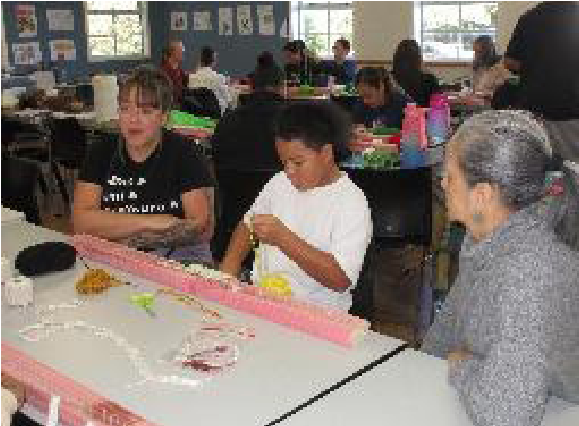 |
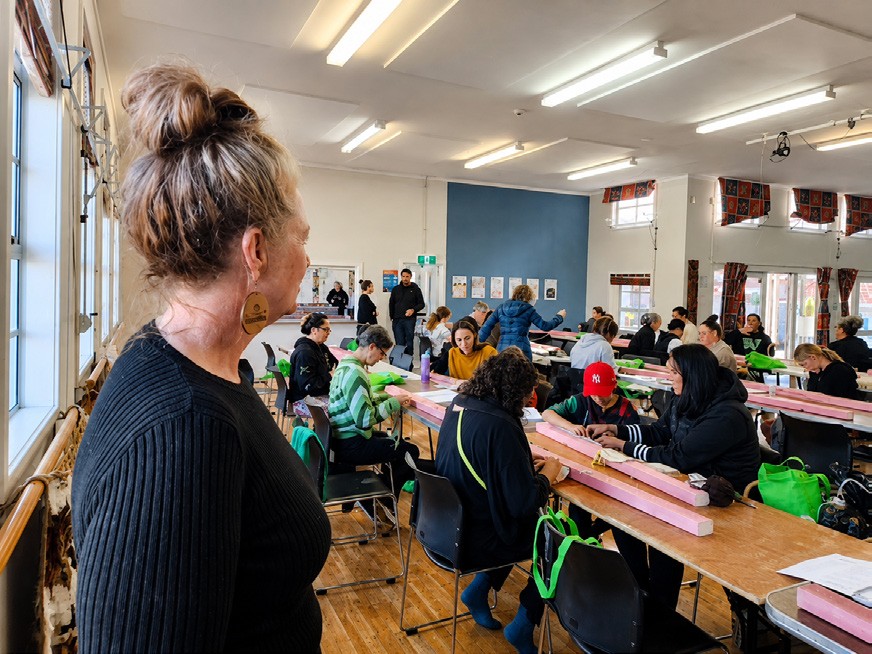
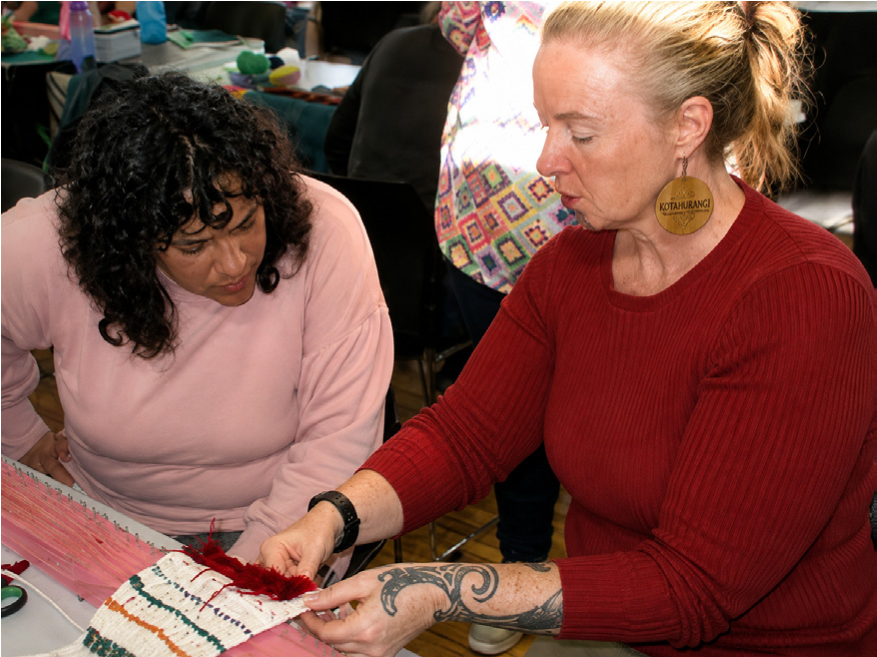
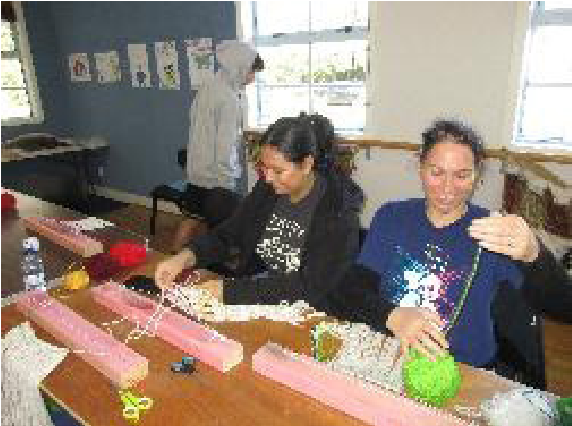
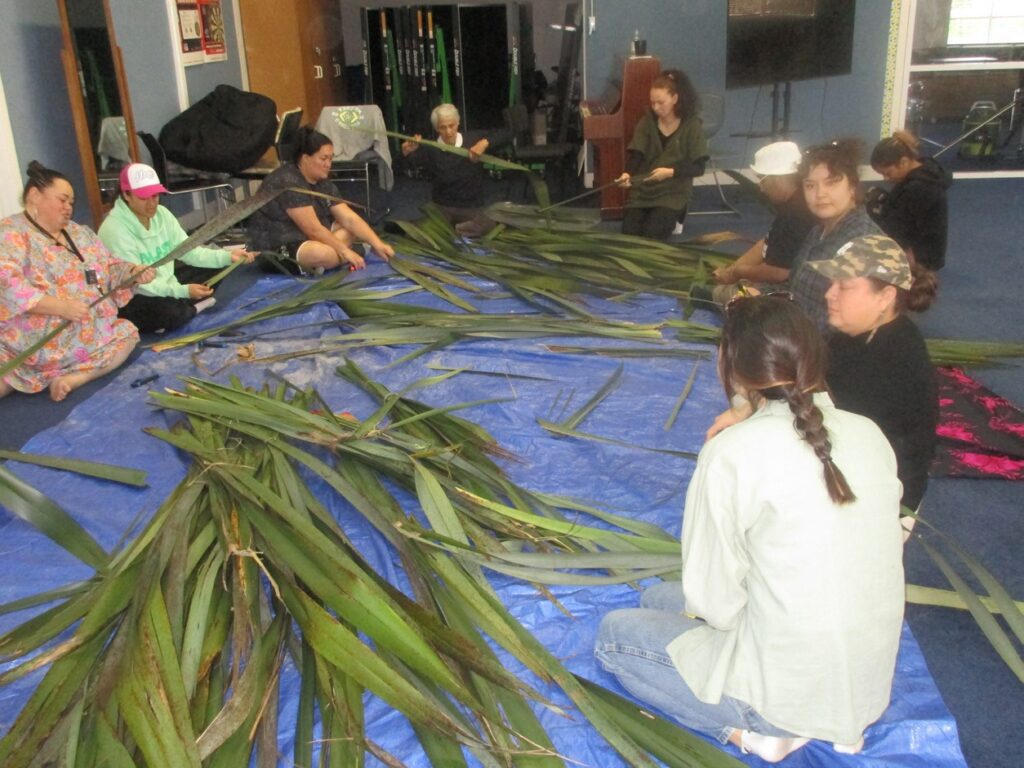
| Whatu wānanga whānau participants (Photo credit: Research team. Participants gave consent to use images.) |
||
2. An aho to the ancestors
Aho (weft threads) are metaphorical connectors to the past and the future that act as tangible and substantive links between ancestors and their living descendants (Henare, 2005; Smith, 2020). When whānau participants connected the aho they were weaving with their hands to the idea of aho as a connection to tūpuna, they recognised the whatu kākahu they were making as bringing forth an ancestral energy to “live on” in the present:
Whatu is something I had always thought about doing, but where? How? I knew I wanted some form of creative outlet, and this is it. Whatuora is not just the mahi [practice] that we do here, but how we end up being and becoming the whenu. We are the aho, and our tūpuna are weaving us together. That is reclaiming ancestral knowing, and reclamation in any form is a journey. (Carel)
Whānau recognised that whatu not only connected them to tūpuna knowledge from the past but also wove them together as a connected community in the present. Whatu pedagogy held space for whānau to build and strengthen community and whanaungatanga (kinship):
Whatu is a place to feel safe and supported. It has built so many connections. We have weaved ourselves into each other. It feels like we are all sitting comfortably under the same big korowai [cloak], weaving our stories together. (Jamie)
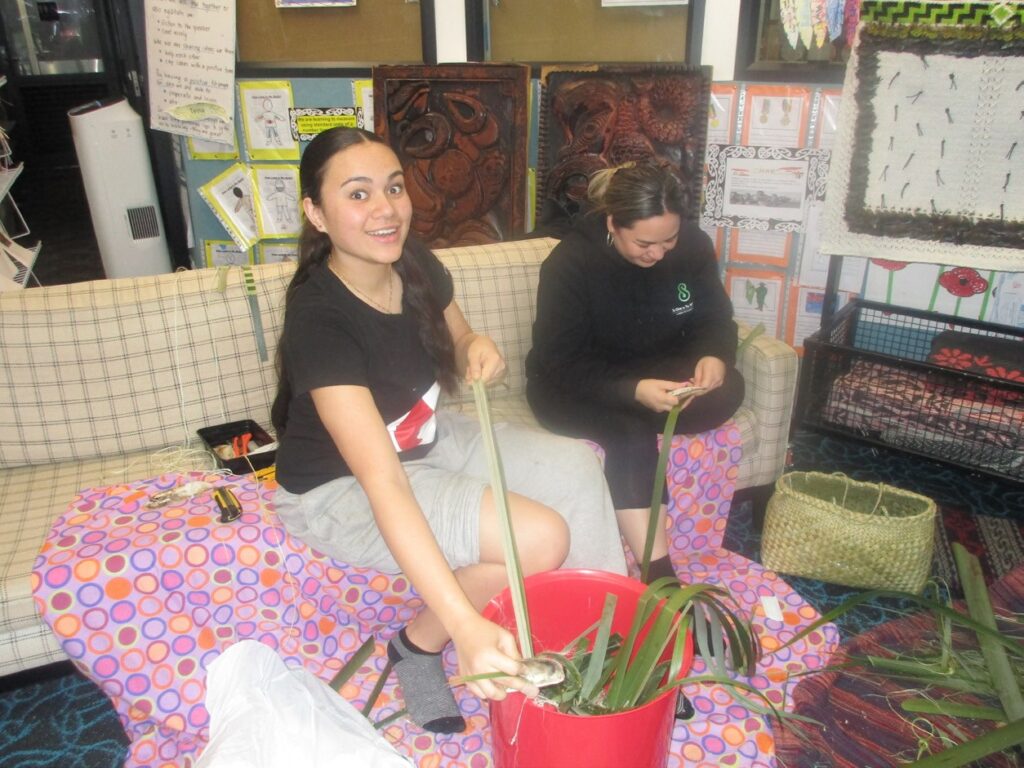
Re-weaving intergenerational knowledge transmission is an important thread in whatu pedagogy, where whānau are encouraged to bring their tamariki to wānanga. In this study, participants did so, with tamariki ranging in ages from 5 to 17. Often, the teenagers contributed to weaving alongside a parent or grandparent, while at other times they would intermittently slink off to be teenagers, care for younger siblings, help prepare food, or just hang out. Having the children attend with participants not only increased accessibility for whānau, but, more importantly, enabled the tamariki mokopuna to be involved in, and present to, the language, knowledge, and practice of whatu as pūtoi ako Māori pedagogy. The research team spoke about the memories that were being formed in their rangatahi minds, and that if the rangatahi were asked as adults about their experience of being around toi Māori, they might recall being in this wānanga space and remember the time and love that their parents and grandparents wove into their cloak.
 |
 |
3. Weaving wellbeing
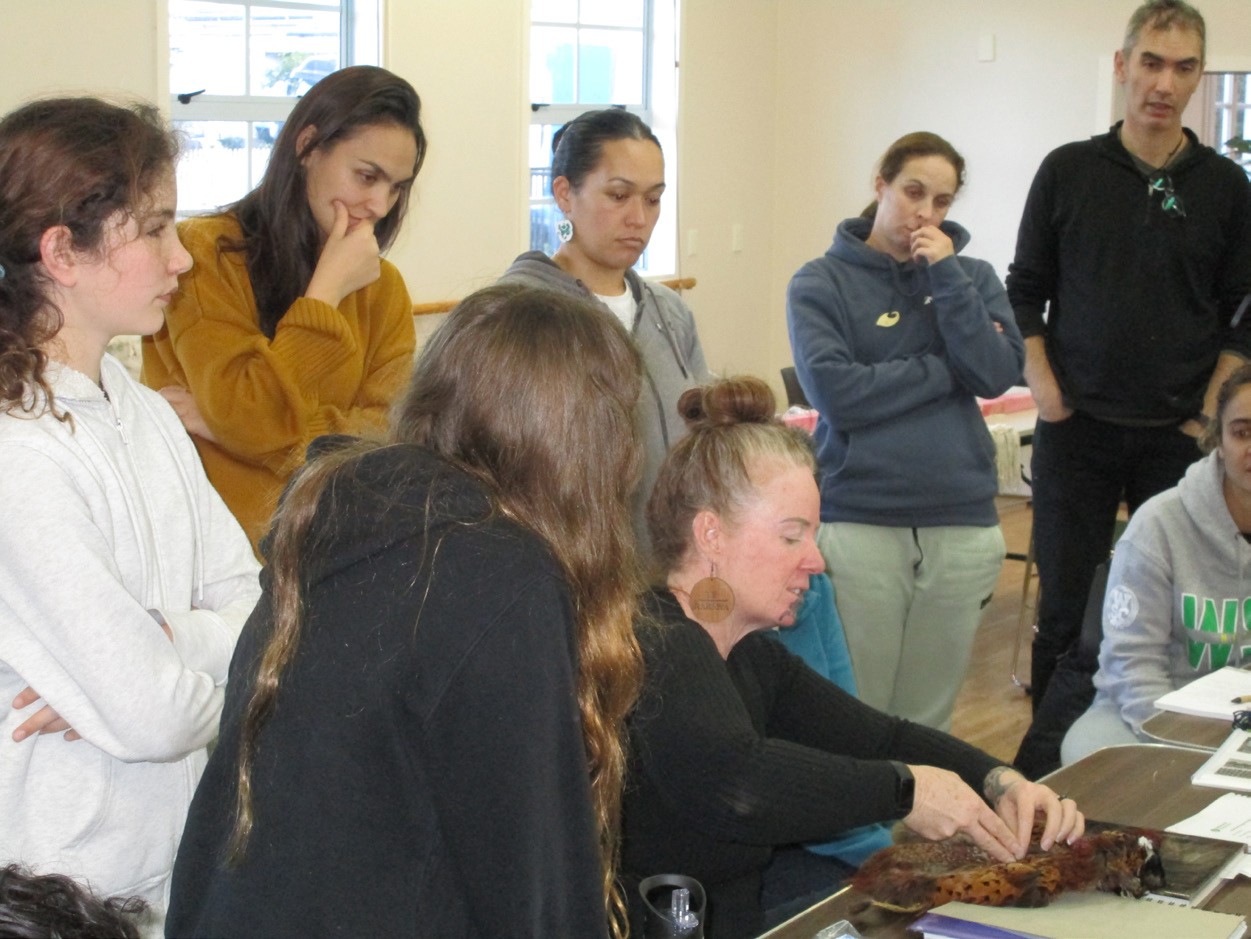
As the wānanga wove and spoke about their collective reo Māori aspirations and connected to the aho of ancestral knowledge across past and present, a deep sense of whānau wellbeing was nurtured. All agreed that whatu sustained their wellbeing, though many spoke of the challenge of finding “whatu time” amidst family, sport, and work pressures. While they longed for more time, whatu often slipped behind other competing priorities. As technical skill and language confidence grew, the wānanga became a place to slow down and centre themselves. The rhythmic movement of whatu engages body, mind, and spirit, inviting a meditative quiet (Royal, 2011; Smith, 2017, 2023). Whatu holds space to talk, laugh, cry—or to rest in the comfortable silence of toi Māori making. As hands move, thoughts and memories are stirred, new ideas emerge, or problems are solved. Kat recalls a moment of silent connection with another Māori woman during a wānanga:
I’m sitting there with Pounamu, both of us doing our whatu. We stare at each other. I breathe out, then she breathes out, and we just kept staring. Then we smile, have a little giggle and a tangi. This exchange happens. Nothing was said, but we know that we are there with and for each other.
Other whānau describe losing themselves in their whatu practice, treasuring the reflective periods of quiet contemplation or “thinking time” to just be and do in their otherwise bustling, urban-located lives.
Similar to other making processes, whatu offers space for relaxation and emotional wellbeing, or to help cope with personal challenges. One māmā (de-identified) describes her upbringing as a hard one where mistakes, however small, were severely punished. As a result, she expressed being afraid to try new things in case she was not perfect or “not enough”. She became conscientised to the limitations her childhood experiences were placing on her confidence to learn:
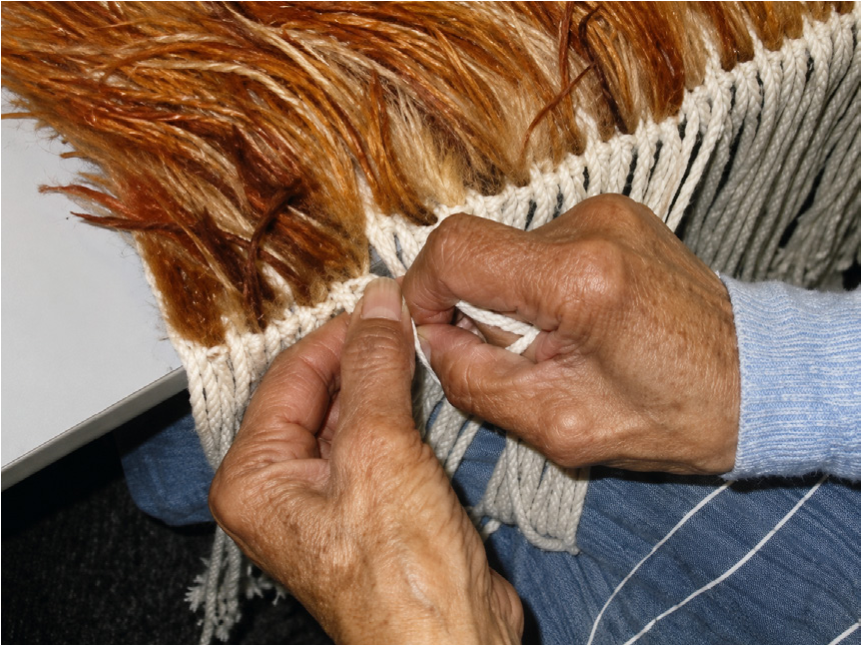
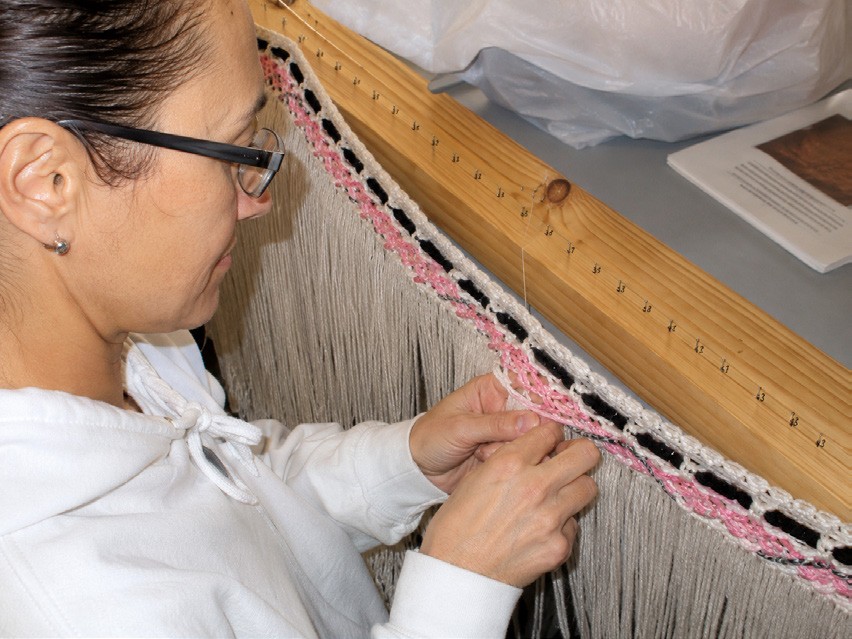
Fear stopped me from trying. I realised I hate making mistakes and I know why, but it’s not a nice story. At the start [of the wānanga], I would undo weeks’ worth of weaving and redo the whole thing because I made that one mistake. I am slowly getting better at being okay with those mistakes. I know now it’s okay to make hapa [mistakes]. I’m still scared to get it wrong, especially in public, but whatu has taught me that mistakes are a normal part of learning. When you make a kākāhu, those mistakes tell your story of learning, just like life—and that’s the healing.
Whatu pedagogy in this community of practice created a safe space to be the learner and not always the expert:
It’s the deliberate absence of threat that makes whatu beautiful. There’s no threat to making a mistake. You are reclaiming this knowledge, and mistakes are part of it. That’s the transformative part. (Kat)
The negative self-talk is disappearing, like, ‘You’re stupid, you can’t do this, you’re not Māori enough.’ Now it’s more like, ‘You’re getting better, you’re doing alright.’ Because this mahi, this space, is healing, it’s calming, grounding. (Moana)
Fears of getting it wrong or not being “Māori enough” permeate deeply into the colonial trauma of revitalising interrupted knowledge systems such as whatu and te reo Māori. Whatu pedagogy intentionally brings our knowing and doing together to weave our strengths, and to disentangle from ideas of inadequacy that can surface for whānau Māori.
|
|
 |
4. Weaving in community
Being in community was fundamental to the project’s success. Whatu wānanga were more than workshops to “learn to make a cloak”. By centring and developing a pūtoi ako toi Māori approach, the wānanga became sites for intergenerational learning and a community of practice that connected the three rumaki reo settings:
It’s not just about the cloak. It’s about the people sitting together, talking, laughing, learning. That’s where the magic happens. (Kat)
Whatu wānanga pedagogy fostered a rich whanaungatanga as relationships were built through shared experience, kai, and kōrero.
5. Language woven through practice
Listening to why whānau Māori choose rumaki reo education helps the Aotearoa New Zealand education sector to understand and respond to their aspirations for flourishing reo and tikanga. Te reo Māori was both a central theme and an integral aho thread of the project, learnt through creative practice rather than alongside it. Several highly proficient whānau participated, including seven rumaki kaiako and two kuia who are first-language speakers. Our nannies’ language was ever present throughout wānanga as they each completed multiple cloaks for their mokopuna. They generously shared stories of being raised in te reo, of suppression, and of now fully engaging alongside their mokopuna in rumaki schooling. These sometimes painful stories deepened parents’ understanding of why the grandparent generation often sought to shield them from the prejudice they once endured. One parent explained:
Last year, the confidence wasn’t even there to do my pepeha, but now, a year on, I can thanks to whatu for a safe space to practice on you poor guinea pigs. My reo journey is still a work in progress, but I am grateful for this space. (Vanessa)
When we’re weaving, the reo just flows. It’s not forced. You pick it up as you go. (Anon)
For many, whatu wānanga as a reo Māori language zone was less intimidating than formal language learning:
I was anxious coming along because whatuora is about reo ora [language vitality], and I am still on my reo journey, but being in this space has been so calming, so welcoming. I love listening to our reo and being surrounded by our reo. There aren’t many spaces like this. We might go to hui where there are bursts of reo, but it’s not cloaking you like it is here. I don’t understand everything that is being said, but I pick up words. (Tracey)
Māori language proficiency is a sensitive subject for whānau Māori participants, many of whom were denied the opportunity to learn the language at home or at school. One hundred and fifty years of overt education policy and more covert, but no less pervasive, social attitudes (Selby, 2014) continue to reinforce hegemonic beliefs that speaking te reo is detrimental to Māori progress. For some Māori, this continues to manifest feelings of shame, language trauma, and inadequacy (Smith, 2017; Webber, 2008). Stories from parents and grandparents were mixed with feelings of misplaced shame and anger. Feelings of inadequacy or not “being Māori enough” manifested in expressed fears of “getting it wrong”:
At whatu, when I am with reo speakers, and I’ve hit my limit and am struggling to keep up, I can feel uncomfortable in that moment, which can take me away from staying engaged. But doing whatu while I listen is like a beautiful interruption for me to stay present. The healing aspect is that, in that moment of discomfort, it can trigger the language trauma, but staying in community, doing the rhythmic practice of whatu helps to keep us bound together in our relationship. (Kat)
To better support less-confident reo Māori speakers, the research team developed printed resources of whatu terminology and instructions in te reo, and encouraged emergent speakers to sit alongside competent speakers during wānanga to encourage language development:
There are not many spaces where te reo is organic like it is here. It’s about deliberately putting yourself in these spaces where reo is not necessarily the focus, so the language learning happens organically. (Shannon)
When the kōrero is flowing at whatu it’s like being at the opera. You can feel it. You can see it. You can hear it—you’re not quite sure what it means, but it still feels beautiful and comfortable. It’s just magic. (Faye)
Being involved in whatu wānanga provided Tracey with the confidence to learn te reo alongside her tamariki:
Being here has encouraged me to get back on my reo journey. I got sidetracked being a māmā with young babies, but I have signed up to full immersion next year. I just love being surrounded by reo. It’s like a cloak I never knew I needed.
These accounts support toi Māori spaces, such as whatu, as transformative sites of language revitalisation, where histories of language oppression are acknowledged, but, importantly, language is reclaimed through relational, embodied, and creative practice.
Summary table
| Theme | Key insights |
|
1. Intergenerational threads |
Whatu wānanga fostered inter- and intragenerational transmission of language, culture, and practice. Families unlearned inherited silences and regenerated knowledge together. |
| 2. Aho to the ancestors | Aho connect past and future; whatu became a tangible act of reclamation, fostering whanaungatanga and linking tūpuna to present communities. |
| 3. Weaving wellbeing | Whatu supported spiritual, emotional, and mental wellbeing through reflective, safe, and non-threatening learning environments. |
| 4. Weaving in community | Wānanga built strong communities of practice across kura rumaki reo, centring shared histories, language, and creativity. |
|
5. Creativity as cultural expression |
Weaving was both an artform and a pedagogical approach, blending tikanga with innovation and intergenerational storytelling. |
|
6. Language through practice |
Te reo Māori was woven through practice organically. Whatu spaces enabled language reclamation, addressed trauma, and built confidence. |
Dissemination
The project produced three published academic outputs (one in press) and two book chapters (in press).
Published journal articles
Goldsmith, A., Smith, H., & Penetito, K. (2024). Toi ako—Developing Māori arts pedagogy: A kaupapa Māori literature review. Occasional and Discussion Paper 2/2024. Unitec ePress. https://doi.org/10.34074/ocds.111
Penetito, K., & Smith, H. (2025). Whatua te muka tāngata: Indigenous cloak-making as a site of healing and resistance (Occasional and Discussion Paper 1/2025). Unitec ePress. https://doi.org/10.34074/ocds.112
Smith, H. (2025). Toi ora, whatuora: Exploring whatu pedagogy and wellbeing. MAI Journal: A New Zealand Journal of Indigenous Scholarship, 14(2), 109–124. https://doi.org/10.20507/MAIJournal.2025.14.2.1
Journal article—in progress
Weaving cultural and language thrivance—a Māori arts-based approach to intergenerational language and cultural revitalisation. To the Journal of Critical Race and Ethnic Studies special issue on “Enduring Indigenous Voices and Perspectives Amidst the Ongoing Structures of Colonialism”.
Book chapters in press
Māori weaving with a/r/tographic threads: Whatu tāniko as decolonising praxis. The International Handbook of A/r/tography.
Smith, H. (In press). Weaving Māori hearts and minds: Māori weaving as decolonising praxis, theoretical thinking and methodological doing. In E. Fitzpatrick, Y. Wang, R. C. Reilly, & S. Park (Eds.), The Routledge handbook of making: Craft-based research methods and pedagogy. Routledge.
Research team presentations
IIRC (International Indigenous Research Conference), Auckland, November 2024.
ITAC (International Teaching Arts Conference), Auckland, June 2024.
International Indigenous conference presentation
Reclaiming Indigenous Ecologies of Love RIEL Indigenous Health Conference, New Mexico, April 2025 (selffunded)
Lowitja International Health Conference, Adelaide, June 2025 (external co-funding)
Practitioner teaching community presentations to Te Kāhui Ako o Te Waitematā. Attended by the kaiako and leaders of each school.
Principal investigator Hinekura Smith led two Kāhui Ako o Waitematā workshops in 2023 and 2024 at Western Springs College.
Community dissemination activities:
He Rerenga Kakahu—fashion show titled He Kahu Kōrero Cloaks that Speak: A love letter to my mokopuna. Held on 12 June 2025 at Te Noho Kotahitanga Marae, Unitec, Auckland. Attended by extended whānau, kaiako, research team, researchers, and funder.
Fashion Show film

https://www.youtube.com/watch?v=6MyEaauw65M
See an example of three “love letters” in Appendix 1.
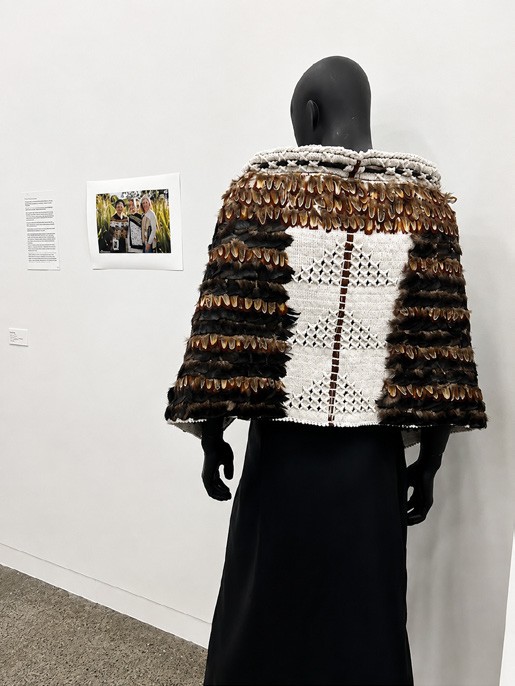
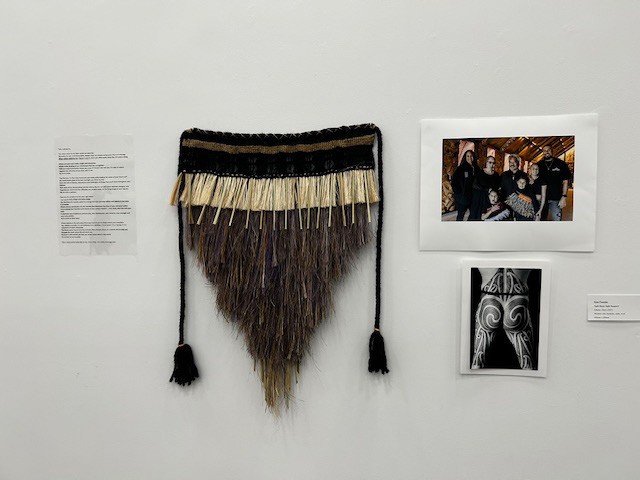
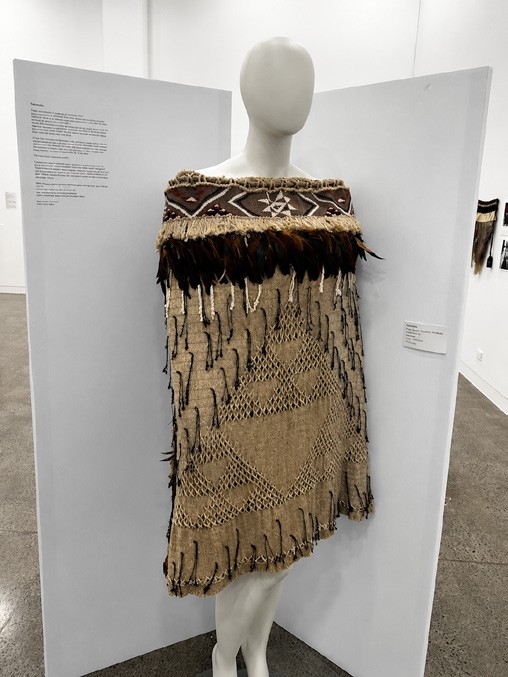
Gallery Exhibition held at Toi o Wairaka Gallery, Unitec, June–July 2025, displayed 12 whatu kākahu with professional whānau portraits and the accompanying “love letter”.Wānanga footage and snippets of interviews were played on a video loop, creating an all-round toi Māori sensory environment.
 |
 |
 |
 |
||
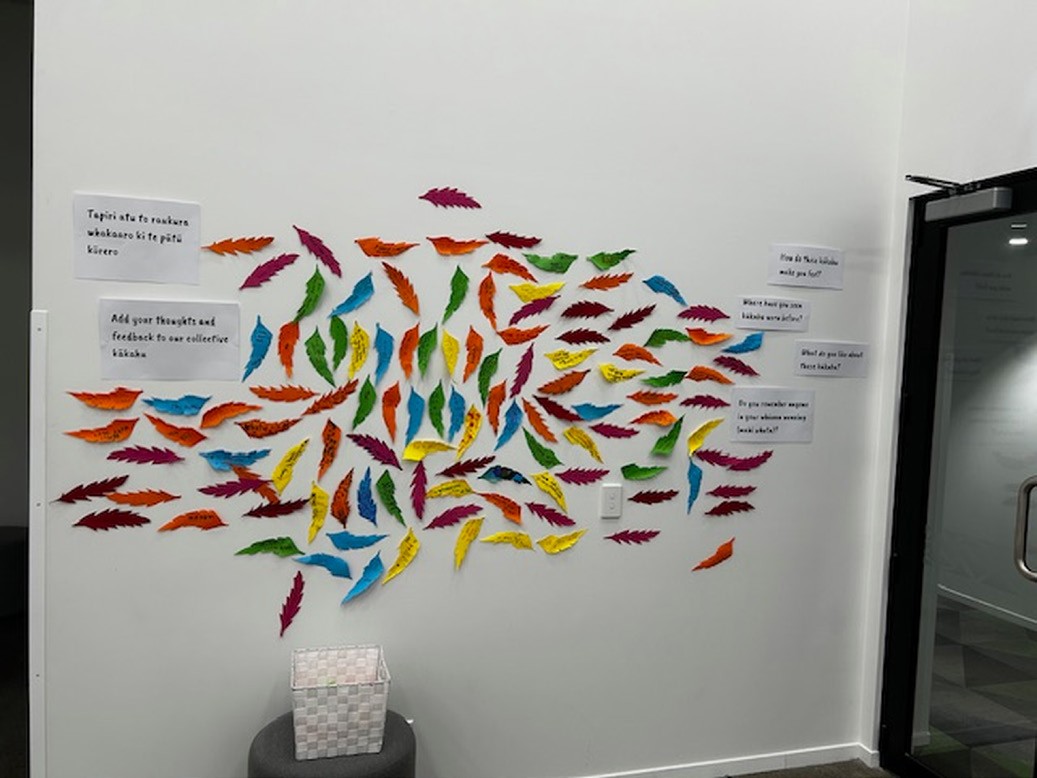
A “pātū kōrero” (talking wall) for visitor feedback
The 3-week-long exhibition welcomed approximately 350 visitors, including local primary and secondary school groups, tertiary students, artists, community, weavers, staff, and researchers. As a strategy to gather feedback, we set up a “pātū kōrero” (talking wall) to invite visitors to add their feathers and feedback.

Implications for Māori-medium education integrating toi Māori pedagogies
The research findings reinforce the critical role of toi Māori pedagogy “as teacher”, offering threads to be picked up and woven into Māori-medium and Englishmedium education. Kaiako and whānau Māori implore curriculum designers and government policy makers to support Māori-medium schooling futures that are not only academically and output driven, but culturally, linguistically, and creatively generative—not as a request, but as part of the Crown’s Tiriti obligations to protect taonga Māori. By theorising and practising toi Māori as pedagogy, creative practices such as whatu, raranga, haka, hākinakina, and so forth become more than extracurricular activities on a timetable and are recognised as rich languagegeneration zones, places where te reo Māori is lived and where learning flourishes. “Māori art” has a place in the curriculum, but this project prompts Māori educators to consider further the regenerative nature of toi Māori pedagogy focusing on not only what Māori creative practices are taught, but also how and why toi Māori is taught. The project’s key implications are summarised below.
1. Repositioning toi Māori pedagogy
Often, toi Māori are treated as the hukahuka (decorative tassels on a cloak) or something to fit around literacy and numeracy. Within the rhythmic twisting of aho, language, identity, and community are not separate strands; they are entwined. These are not accidental byproducts of toi Māori—they are its essence. Whatu, raranga, kowhaiwhai, haka, tā moko, and other toi Māori are epistemic spaces where critical, linguistic, cultural, and relational learning are all enabled. In Māori-medium education settings, this means a purposeful repositioning of toi Māori as foundational pedagogical practice. Toi Māori is not a break from learning; it is a way of knowing, a way of theorising, and a way of being. It asks curriculum writers and educational leaders to position toi Māori as an essential aho in the fabric of teaching and learning. Furthermore, further theorisation and implementation of toi Māori pedagogy is an opportunity to explore the inherent mathematical and scientific logics embedded within these forms, expanding how Māori literacies and numeracies are conceptualised and practised.
2. Supporting kaiako as artists, practitioners, and knowledge holders
Kaiako Māori are weavers, carvers, language carriers, story holders and tellers that breathe life into the classroom. This project was shaped by kaiako who were also artists and researchers. Supporting Māori-medium kaiako means making space and time for them to deepen their toi creativity—their own toi aho to the ancestors. It means recognising and remunerating the cultural and creative knowledge they bring. It also calls for fostering partnerships between kaiako and toi Māori whānau, actively binding relationships where collective creative and pedagogical energies can flourish for the benefit of tamariki and whānau Māori. When kaiako see themselves as active cultural practitioners, researchers, and developers of theory and pedagogy, they bring a depth of embodied knowledge into the learning space.
3. Embedding language learning in practice-based contexts
Language thrives where it is lived. The whatu wānanga revealed that te reo Māori flowed more naturally when hands were busy and hearts were engaged with purpose— in this case, whānau aspirations to make a kākahu for their child. In these creative spaces, language learning was not formalised but became the atmosphere, the heartbeat, the background hum. Whānau described feeling less anxious and more confident when language learning was intertwined with making, laughter, and shared purpose. It is a powerful encouragement for kura to intentionally design language-rich, creative spaces where reo is woven seamlessly through daily practice, and to look for opportunities for this learning to be intergenerational and transgenerational—language learning modes that deserve further research attention.
4. Strengthening community and whānau engagement
A rewarding outcome of this project was observing whānau connect through the shared desire to learn and weave together as grandparents, parents, teenagers, and children sat side by side, sometimes weaving, sometimes watching, sometimes simply being together. Stories were shared across generations of language loss, but importantly, of courage and determination to not sit back and watch, but to change the narrative from within their whānau. Stories of struggles and solutions were important for tamariki mokopuna to hear.
5. Resourcing toi Māori pedagogies
Weaving a cloak, like revitalising language and culture, takes time—it requires materials, spaces, kai, koha, and relational patience. These are not incidental extras; they are part of the pedagogy itself. Education funding often prioritises short-term, academic output-focused curriculum, but Māori-medium schooling thrives on long-term, relational investment. Toi Māori pedagogies require resourcing that recognises their role in language and cultural regeneration. This means investing in toi Māori practitioners as educators, researchers, and curriculum developers by acknowledging the expertise they carry and creating sustainable pathways for them to work within and alongside kura.
6. Contributing to knowledge, pedagogy, and curriculum
Articulating whatu pedagogy as a “new” Māori educational pedagogy contributes to the living, breathing whakapapa of Māori-medium education, one that is grounded in practice, community, and intergenerational learning. Toi Māori are pedagogical anchors, holding cognitive, affective, linguistic, and cultural dimensions together (Goldsmith et al., 2024). They offer Māori-defined ways of teaching and learning that bring forth ancestral knowledge in new and relevant ways to support contemporary Māori education realities. This work contributes to the evolving field of culturally (re)generative pedagogy and encourages other Māori and Indigenous educators to continue to decolonise teaching and learning through our own culturally rich creative modes.
7. Equity, language revitalisation, and systemic change
Māori-medium schooling exists within a broader education system that privileges Western epistemologies. By bringing toi Māori pedagogies, such as whatu, to the centre we open pathways for systemic decolonising transformation—for equity, for thriving reo Māori, and for education pathways that reflect who we are and what we want for our tamariki mokopuna. Policy must follow practice, not vice versa. This means expanding scholarship and practice on Māori pedagogies more broadly within national language and education strategies. It means recognising toi Māori and te reo Māori not as optional extras but as essential building blocks of an equitable and thriving education system. This project calls for a shift from treating toi Māori as enrichment to recognising it as the pedagogical heart of Māori-medium schooling.
Summary
| Theme | Key implications |
|
1. Intergenerational threads |
Strengthening intergenerational learning is crucial for sustaining language and cultural practice. Educational spaces should actively centre whānau participation across generations. |
| 2. Aho to the ancestors | Creative practice can be a powerful vehicle for ancestral connection and community cohesion, deepening cultural identity. |
| 3. Weaving wellbeing | Embedding cultural practice in everyday life supports holistic wellbeing, self-confidence, and healing from intergenerational trauma. |
| 4. Weaving in community | Community-led spaces strengthen networks, encourage participation, and sustain collective cultural practice beyond formal education settings. |
|
5. Creativity as cultural expression |
Creative expression supports identity formation, intergenerational storytelling, and dynamic cultural continuity. |
|
6. Language through practice |
Embedding language learning within cultural practice normalises reo use, builds confidence, and supports whānau-led language revitalisation. |
Conclusion
Toi Ora, Reo Ora, Whatuora! set out to explore how whatu as a “new” toi Māori pedagogy can be positioned within Māori-medium education to support intergenerational language revitalisation, cultural identity, and community wellbeing. Over the course of a year, the project unfolded through a series of whatu wānanga, interviews, and creative writing processes with whānau across three connected kura rumaki reo. These wānanga created spaces where grandparents, parents, children, and mokopuna learnt, spoke, wove, and reflected together. Māori education research demands Māori “outputs” beyond academic literature to ensure that findings are accessible and meaningful, but more importantly, return the knowledge to where it belongs—whānau and tamariki Māori.
The research’s two interwoven data sets revealed a nuanced picture of how three Māorimedium education communities are enacting language and cultural regeneration in their everyday lives. Seven interrelated themes emerged—intergenerational learning, ancestral connection, wellbeing, community, creativity, language through practice, and systemic resourcing—which together demonstrate that toi Māori pedagogies are not peripheral enrichment activities but powerful pedagogical, linguistic, and cultural vehicles that can transform learning environments.
This project evidences the ways Māori-medium communities and educators are already weaving language and culture into the daily lives of tamariki mokopuna. It shows that whatu pedagogy operates simultaneously as a creative practice that connects people to ancestors, and to one another; as a pedagogical strategy that supports language acquisition, critical thinking, and identity formation; and as a decolonising pedagogy that centres Māori ways of being, doing, and making together. Whatu wānanga became relational, reflective spaces that encouraged language to flow and confidence to grow. Whānau who might not have seen themselves as “writers” or “researchers” became powerful authors of their own stories, contributing written letters, spoken reflections, and woven taonga tuku iho (heirloom treasures) to the research.
The project provides clear evidence that toi Māori, such as whatu, raranga, haka, and more, are not simply cultural activities but pedagogical frameworks that support language, identity, and wellbeing that is intergenerational. By centring whānau experiences and aspirations and creating spaces for grandparents, parents, children, and mokopuna to learn alongside one another, learning through toi Māori is not confined to the classroom, but becomes a collective and intergenerational. Embedding language through creative practice created a relational, context-rich learning space. Whatuora methodology (Smith, 2017), and whatu as pedagogy, contribute to Māori and Indigenous education scholarship to encourage other a/r/tographers to adapt and build on in their context.
Beyond this research, the team intend to publish the whānau love letters to mokopuna, amplifying community voice in the national conversation on language and cultural revitalisation. Toi Māori pedagogical theory could be extended to other creative practices such as raranga, haka, moko, and hākinakina, using intergenerational wānanga models and scaled to other kura and communities. Longitudinal research could follow tamariki and mokopuna who participate in such reo-rich creative environments to understand how these experiences shape their identities and language trajectories.
Toi Ora, Reo Ora, Whatuora! began with a simple proposition that “learning to weave a cloak” could be a powerful site of language, story, and knowledge transmission. What unfolded was much more profound. When toi Māori pedagogies are centred within Māori-medium education, they activate ancestral connections, strengthen whānau relationality, and create transformative inter-, intra-, and transgenerational learning spaces. Deepening our theoretical and applied understanding of toi Māori pedagogy recognises that our creative ways of being, doing, and making are more than decorative hukahuka on a cloak—they are the aho matua or central threads in the cloak of thriving Māori futures.
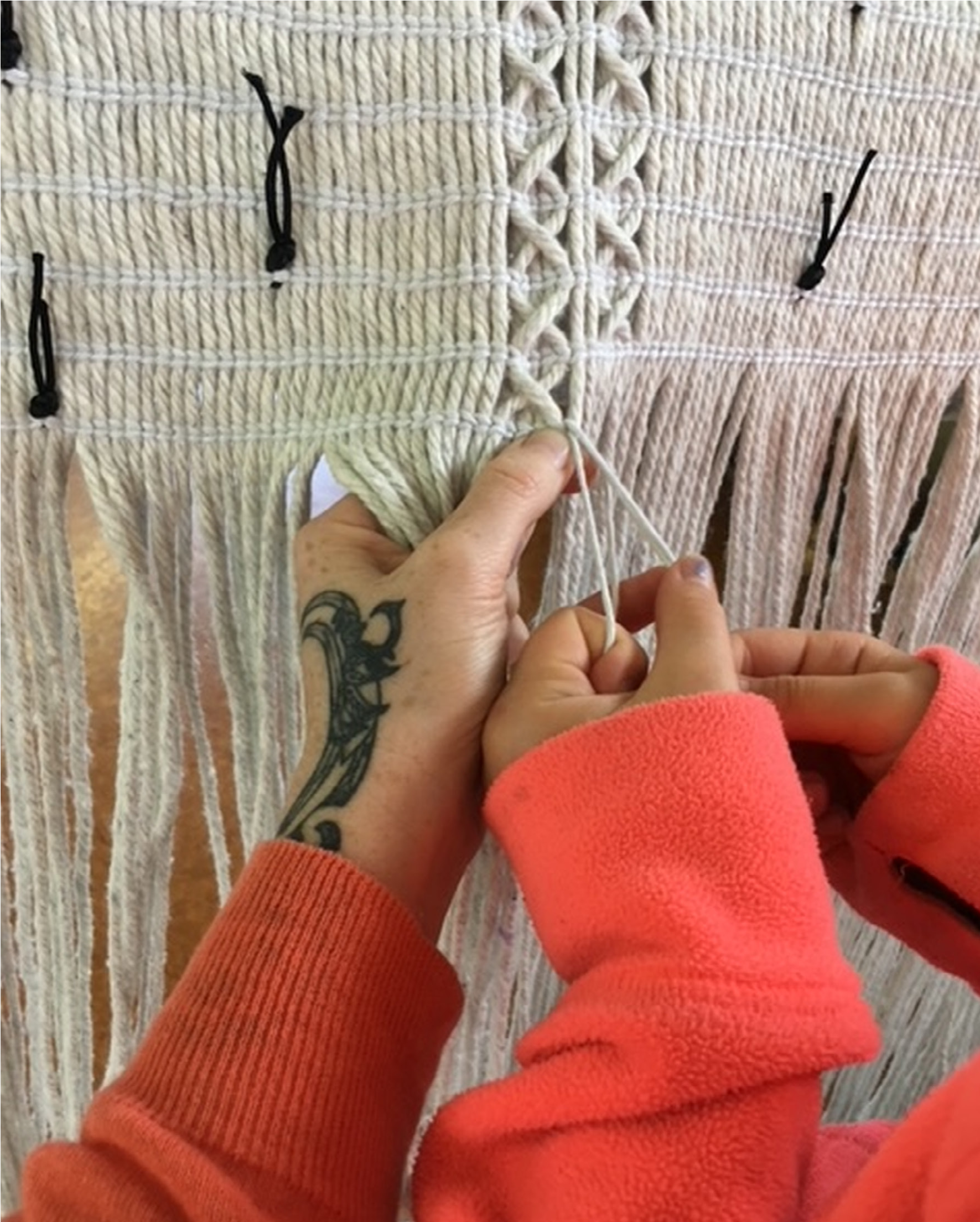
Project team
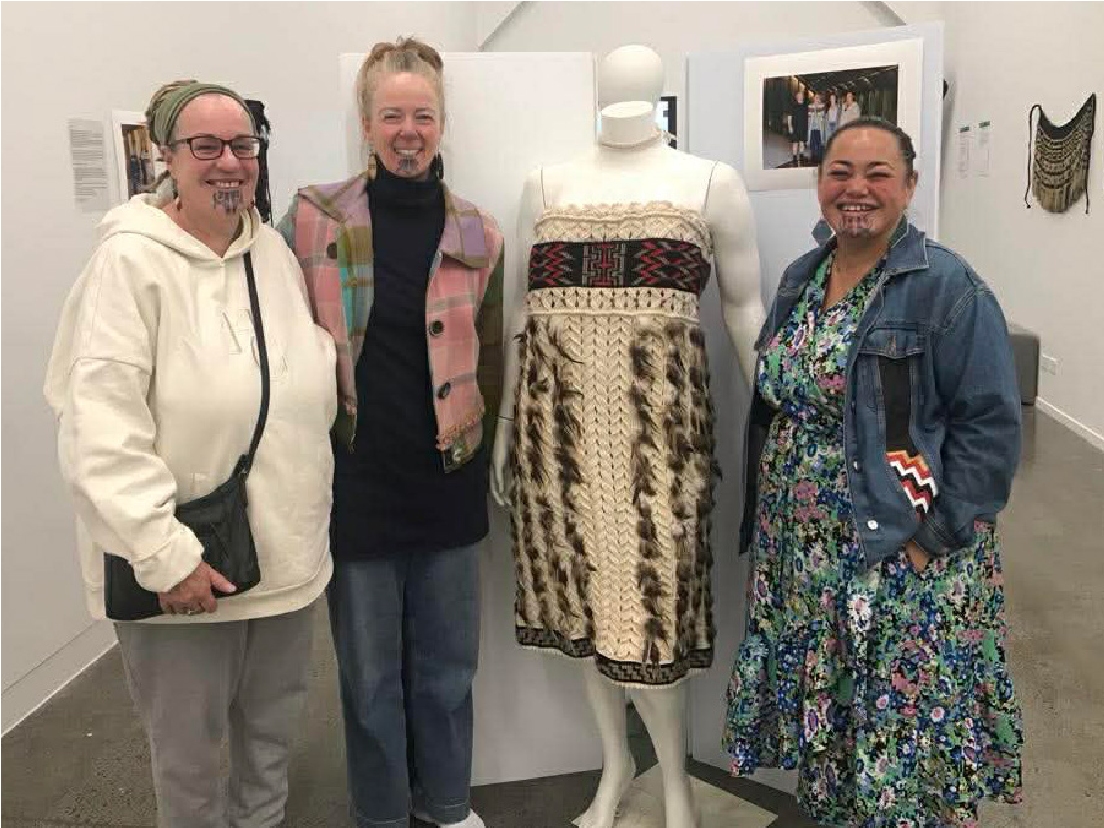
Associate Professor Hinekura Smith (Te Rarawa, Ngāpuhi) is principal investigator of the Toi Ora, Reo Ora, Whatuora research project, former director of Ngā Wai a Te Tūī Māori and Indigenous Research Centre at Unitec, Te Pūkenga and currently principal researcher at the ARC Indigenous Futures Centre, University of Queensland. An artist–researcher–teacher, her scholarship and practice have advanced praxis on whatu and toi Māori pedagogies, weaving together in-community creative practice, kaupapa Māori theory, and education. Her research centres Māori language revitalisation, intergenerational knowledge transmission, and culturally generative pedagogies to nurture spaces where language, culture, and creativity flourish. Her work spans academic publications, creative exhibitions, community wānanga, and international presentations, contributing to Māori educational transformation and Indigenous arts-based research in Aotearoa New Zealand and beyond.
Kim Penetito (Ngāti Hāua, Ngāti Tamaterā) is an associate investigator on the Toi Ora, Reo Ora, Whatuora research project and a member of Ngā Wai a Te Tūī Māori and Indigenous Research Centre at Unitec, Te Pūkenga. A skilled whatu weaver with over a decade of practice, Kim brings deep expertise in toi Māori pedagogy and its application in Māori-medium education. Kim’s commitment to Māori language and cultural revitalisation is grounded in relational practice and community engagement. She works to create spaces where language, creativity, and identity thrive, supporting whānau to revitalise ancestral knowledge while imagining flourishing Māori futures. Working alongside the principal investigator, Associate Professor Hinekura Smith, she helped codesign and lead weekend whatu wānanga, contributed to academic research outputs including lead authorship, and was integral in the success of the He Kahu Kōrero fashion show and gallery exhibition as creative dissemination outputs.
Allana Goldsmith (Ngāti Porou, Ngāi Tai) is a Māori vocalist and emerging researcher who has been actively involved in language revitalisation for herself, her family and community for over 20 years. In 2023 Allana successfully completed a practice-led research Master of Music (1st Class) from the University of Auckland Waipapa Taumata Rau and will begin a PhD in 2026. Allana was research assistant, creative director, and community event organiser for the project bringing a wealth of lived creative experience and community connection to the team as part of the projects aim to grow emerging kaupapa Māori a/r/tographers.
He kuputaka | Glossary
| aho | weft threads |
| āhua | appearance; state of being |
| hapa | mistake/s |
| hukahuka | decorative tassels on a cloak |
| korowai | cloak |
| mamae | pain, hurt, trauma |
| mihimihi | a structured process of greeting or acknowledgement; introductions |
| mokopuna | grandchild or descendant |
| pātū kōrero | talking wall |
| pepeha | statement of tribal affiliations |
| pūtoi ako | pedagogy |
| rumaki reo | Māori-language immersion |
| tamaiti | child |
| tamariki | children |
| tangi | cry |
| taonga tuku iho | values, beliefs, and ideas transmitted intergenerationally; heirloom treasures |
| tauira | student/s |
| tikanga rangahau | cultural and institutional ethical considerations |
| toi Māori | Māori creative practice |
| tupuna/tūpuna | ancestor/s |
| whakaaro | thought; a prompt, question, or provocation |
| whānau | broad notion of family |
| whanaungatanga | kinship |
| whatu | traditional Māori weaving practice used to make cloaks; finger weaving |
| whatu kākahu | Māori cloaks woven using the practice of whatu |
Ngā tohutoro | References
Durie, M. (1998). Te mana, te kāwanatanga: The politics of Māori self-determination. Oxford University Press.
Durie, M. (2003). Nga kahui pou—Launching Māori futures. Huia Publishers.
Goldsmith, A., Smith, H., & Penetito, K. (2024). Toi ako—Developing Māori arts pedagogy: A kaupapa Māori literature review. Occasional and Discussion Paper 2/2024. Unitec ePress. https://doi.org/10.34074/ocds.111
Hemara, W. (2000). Māori pedagogies: A view from the literature. New Zealand Council for Educational Research.
Henare, A. (2005). Nga aho tipuna: Genealogies, material culture and memory. In S. Küchler & D. Miller (Eds.), Clothing as material culture (pp. 121–138). Berg Publishers. https://doi.org/10.2752/9780857854056/CLMATCULT0010
Higgins, R., Rewi, P., & Olsen-Reeder, V. (Eds.). (2014). The value of the Māori language. Huia.
Irwin, R., & Springgay, S. (2009). A/r/tography as practice-based research. In S. Springgay, R. Irwin, C. Leggo, & P. Gouzouasis (Eds.), Being with a/r/tography (pp. xix–xxxii). Sense Publishers. https://doi.org/10.1163/9789087903268
Ministry of Education. (2008). Ka hikitia: Managing for success—The Māori education strategy 2008–2012. Author.
Ministry of Education, & New Zealand Teachers Council. (2011). Tātaiako: Cultural competencies for teachers of Māori learners. Ministry of Education.
Penetito, K., & Smith, H. (2025). Whatua te muka tāngata: Indigenous cloak-making as a site of healing and resistance. Occasional and Discussion Paper 1/2025. Unitec ePress. https://doi.org/10.34074/ocds.112
Rangiwai, B., Croul, M., Goldsmith, A., Fletcher, M., & Moses, A. (2023). Using kaupapa Māori research to inform practice. Unitec ePress Occasional and Discussion Paper Series (2023:3), 1–12. Unitec ePress. https://doi. org/10.34074/ocds.10
Royal, T. A. C. (2011). Wānanga: The creative potential of mātauranga Māori. Mauriora-ki-te-Ao/Living Universe Ltd.
Selby, R. (2014). Still being punished: Stories of punishment for speaking Māori. Huia.
Simon, J., & Smith, L. T. (2001). A civilising mission? Perceptions and representations of the New Zealand native schools system. Auckland University Press.
Smith, H. (2017). Whatuora: Whatu kākahu and living as Māori women. [PhD thesis,The University of Auckland] https://researchspace.auckland.ac.nz/handle/2292/36334
Smith, H. (2019). Whatuora: Theorizing “new” indigenous research methodology from “old” indigenous weaving practice. Art/Research International, 4(1), 1–27. https://doi.org/10.18432/ari29393
Smith, H. (2020). “Cloaked in our aspirations”: Māori mothers and grandmothers weaving stories from their past for the future. Journal of Indigenous Wellbeing, 5(1), 79–89. https://journalindigenouswellbeing.co.nz/ journal_articles/cloaked-in-our-aspirations-maori-mothers-and-grandmothers-weaving-storiesfrom-their-past-for-the-future/
Smith, H. (2021). Whatuora: Theorising a kaupapa Māori arts-based methodology. MAI Journal, 10(2), 191–201. https://doi.org/10.20507/MAIJournal.2021.10.2.12
Smith, H. (2023). Re-weaving thinking, re-thinking weaving: Theorizing indigenous arts practice as research methodology. In: R. J. Tierney, F. Rizvi, & K. Erkican (Eds.), International encyclopaedia of education (Vol. 3, pp. 181–188). Elsevier. https://dx.doi.org/10.1016/B978-0-12-818630-5.06049-8.
Smith, H. (2025). Toi ora, whatuora: Exploring whatu pedagogy and wellbeing. MAI Journal: A New Zealand Journal of Indigenous Scholarship, 14(2), 109–124. https://doi.org/10.20507/MAIJournal.2025.14.2.1
Smith, H., Frandi, A., Squire, D., Farnham, I., Morgan, E., Keepa, D., & Morunga, P. (2022). Growing kaupapa Māori research capabilities and confidence through whanaungatanga as research mentorship. Unitec ePress Occasional and Discussion Paper Series (2022: 1). https://doi.org/10.34074/ocds.098
Smith, C., & Laing, R. (2011). What’s in a name? The practice and politics of classifying Māori textiles. Textile History, 42(2), 220–238.
Smith, H., Sarich, J., Eruera, T., Campbell-Strickland, A.-M., & Mato Bartlett, L. (2023). Whakarongo ki te tangi!— Listen to our tears, listen to our call! Learnings from a summer research mentorship to grow kaupapa Māori community health researchers. Unitec ePress Occasional and Discussion Paper Series (4/2023). 1–12. Unitec ePress. https://doi.org/10.34074/ocds.105
Tamarapa, A. (Ed.). (2011). Whatu kākahu. Te Papa Press.
Te Kanawa, K., & Turi-Tiakitai, J. (2011). Te mana o te kākahu. In A. Tamarapa (Ed.), Whatu kākahu (pp. 19–32). Te Papa Press.
Walker, R. (2004). Ka whawhai tonu matou: Struggle without end. Penguin.
Webber, M. (2008). Walking the space between: Identity and Māori/Pākehā. NZCER Press.
Williams, H. W. (1997). Dictionary of the Māori language (7th ed). GP Publications.
The appendix for this online version of the report had been removed. However, you can access it here